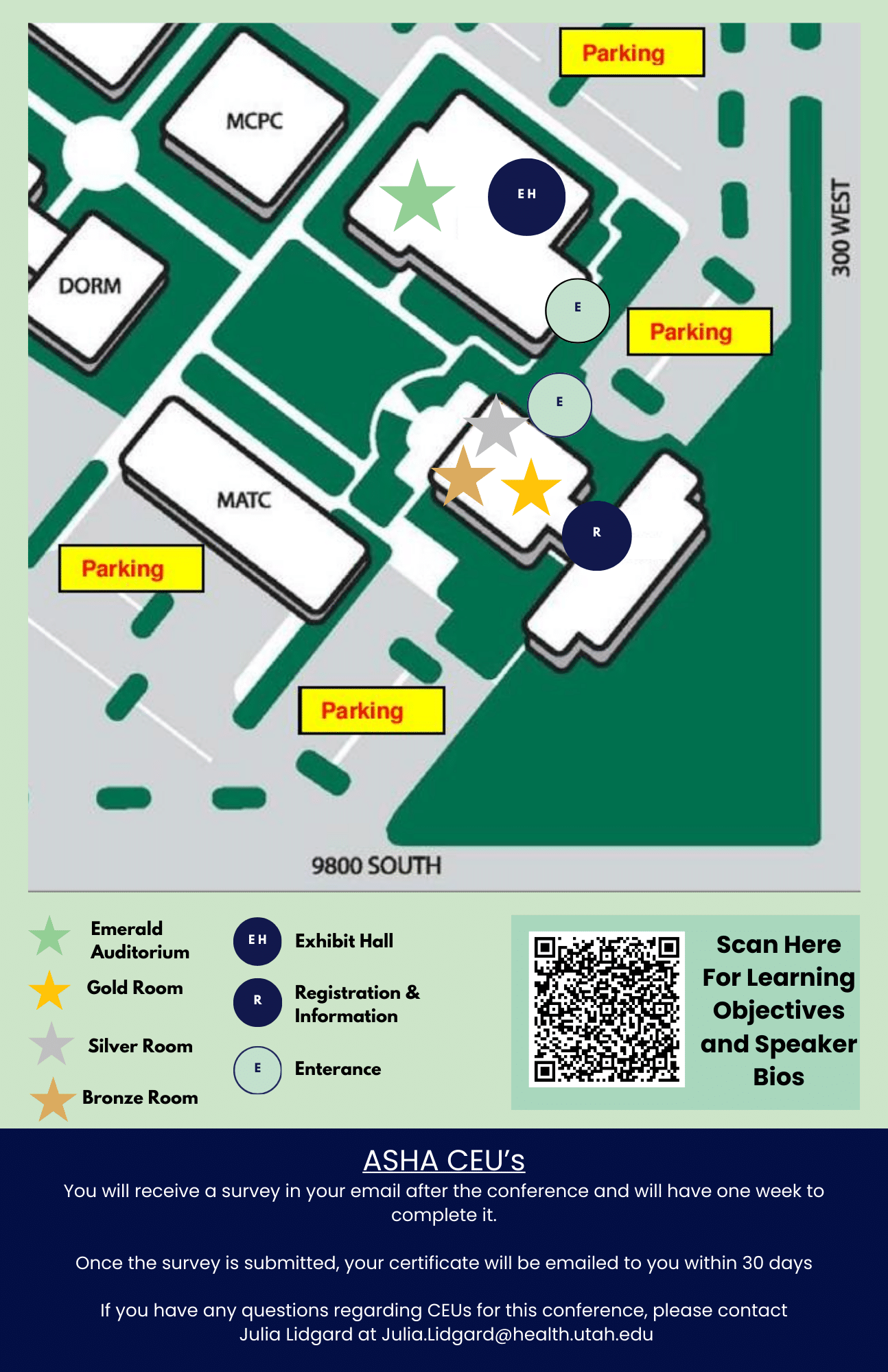
The USHA 2026 Conference will be all live, all in-person, all in one day. The conference will be held at the Salt Lake Community College Miller Campus Conference Center on February 27, 2026.
Address: 9750 S 300 W, Sandy, UT 84070
There will not be an option to attend sessions virtually. Sessions will not be recorded. Registration is required to attend the conference.
Registration Level |
Early Bird Rate |
Standard Rate (starting February 2, 2026) |
Full Registration |
$200 |
$225 |
Student (no CEUs) |
$75 |
$75 |
Note: We will not have a “membership rate” this year. We thank all of our members for supporting the organization, and we welcome new members. If you would like to become a USHA member or update your membership, visit the membership page here.
COURSE DESCRIPTION:
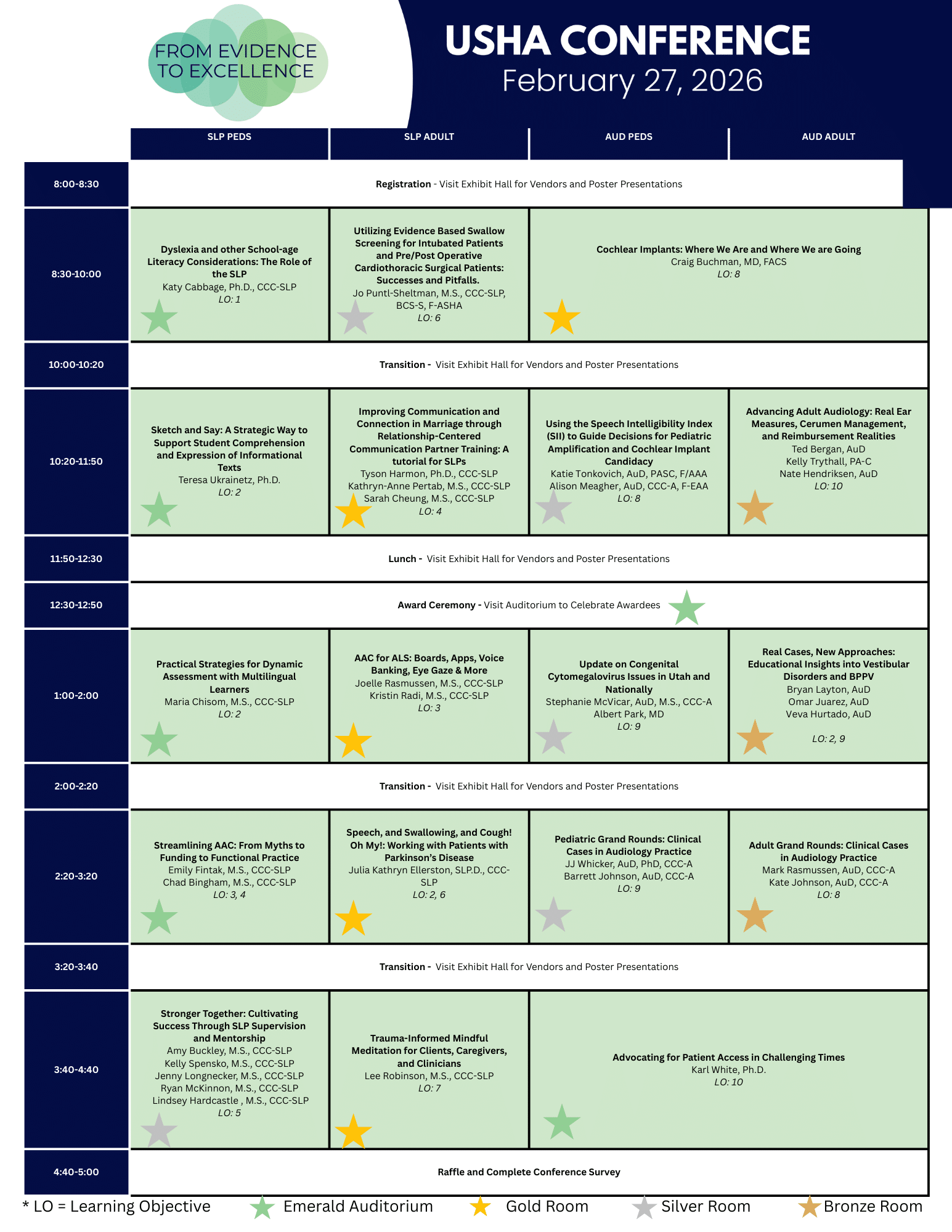
The Utah Speech, Language and Hearing Association presents the annual USHA Conference. Researchers, audiologist, speech-language pathologists, medical doctors, practicing clinicians, and others are invited to present topics of interest to medical based SLPs, school based SLPs and audiologists in a wide variety of work settings. This course provides professional development for speech-language pathologists and audiologists and an opportunity to collaborate and learn from and with each other. Topics included: ethical considerations, case study grand rounds, and updated developments of assessment, intervention, diagnosis, implementation and treatment for both audiology and speech-language pathology.
LEARNING OBJECTIVES (LOs):
Upon completion of this course, participants will be able to:
- Identify and describe evidence-based intervention strategies to support language, literacy, and communication development across pediatric and school-age populations.
- Differentiate and implement contemporary assessment approaches, including dynamic and functional methods, to inform clinical decision-making.
- Identify and apply evidence-based AAC strategies to support individuals with complex communication needs across diagnoses and the lifespan.
- Identify and describe relationship-centered and partner-focused intervention approaches to improve communication outcomes.
- Identify and determine effective mentoring strategies into professional practice as a mentor and/or mentee.
- Identify best practices for screening, assessing, and managing swallowing and airway protection disorders in medically complex populations.
- Identify and describe trauma-informed and mindfulness-based principles to support client care and clinician well-being.
- Identify and distinguish between current cochlear implant technologies, candidacy considerations, and clinical outcomes, including emerging trends and special populations.
- Identify and describe audiologic assessment and habilitation strategies for hard-to-test and diagnostically complex populations.
- Identify and describe best practices and system-level initiatives that improve hearing healthcare delivery and early identification outcomes.
POSTER PRESENTATIONS:
- Novel Methods of Hearing Assessment Using the Sound-Induced Pupil Response (SIPR) by Faith Dryden, AuD, & Kristin R. Knight, MS, CCC-SLP,
- Envisioning an Outreach Program for Stroke Survivors in Rural Utah by Tracy Liu, MS, CCC-SLP, Edric Thorup, BS, Laura Wise, Taylor Haychock, & Tyson Harmon, PhD, CCC-SLP
- The Power of Mindfulness Breathing for School-Based SLPs by Julie A. Stewart, SLPD, CCC-SLP, NBC-HWC, Dawn Girten, SLPC, CCC-SLP & Lisa Froehlich, PhD, CCC-SLP
- Parent-Child Interactions Following a Dialogic Reading Workshop by Connie Summers, PhD, CCC-SLP, Allison Oliver, Nathan Nailon, Samantha Barahona, Elena Rawlins, Maddie Boyer, Danica Kilton & Audrey Rowell
- Interrelationships between Prosody, Sensory Processing, and Emotion in Autism by Brenna Weaver & Garett Cordon, AuD
- Listening Effort Changes With Hearing Aid Experience: An fNIRS Analysis and Implications for Dementia Prevention by Allison Hancock, PhD
- Listener-Perceived Gains in Speech Clarity and Expressiveness Following SPEAK OUT!® Therapy by Russell deJesus, MS, CCC-SLP & Brett R. Myers, PhD, CCC-SLP
- Acoustic Outcomes in Singing “Happy Birthday” Following SPEAK OUT! Therapy for Dysarthria Secondary to Parkinson’s Disease by Emma Davis, BS & Brett R. Myers, PhD, CCC-SLP
- Maintenance of SPEAK OUT! Outcomes for Parkinson’s Disease: 7 Years of “Intent” by Brett R. Myers, PhD, CCC-SLP, Russell deJesus, MS, CCC-SLP & Emma Davis, BS
- Acoustic Assumptions for Transmasculine Voice Therapy by Corey J. Hollinger, MA, CCC-SLP. TSSLD & Brett R. Myers, PhD, CCC-SLP
- Speech Rate and Articulation Rate as Predictors of Perceived Intelligibility in Dysarthria by Kaya Bayne & Morgan Robertson, PhD.
- The Impact of Dysarthric Speech Rate on Listener Fatigue and Frustration by Hallie Dunn & Morgan Robertson, PhD.
This program is offered for up to 0.80 ASHA CEUs (various levels, professional area).